
Life and work
Florentia Sale
1790–1853
Lady Sale · diarist and witness of the First Anglo-Afghan War
The Kabul retreat, recorded from within.
Florentia Sale’s journal follows the collapse of a British position in Afghanistan through the eyes of a woman caught in its consequences. Marching, wounds, rumours and captivity give the campaign the scale of lived days.
Return to the editions ↓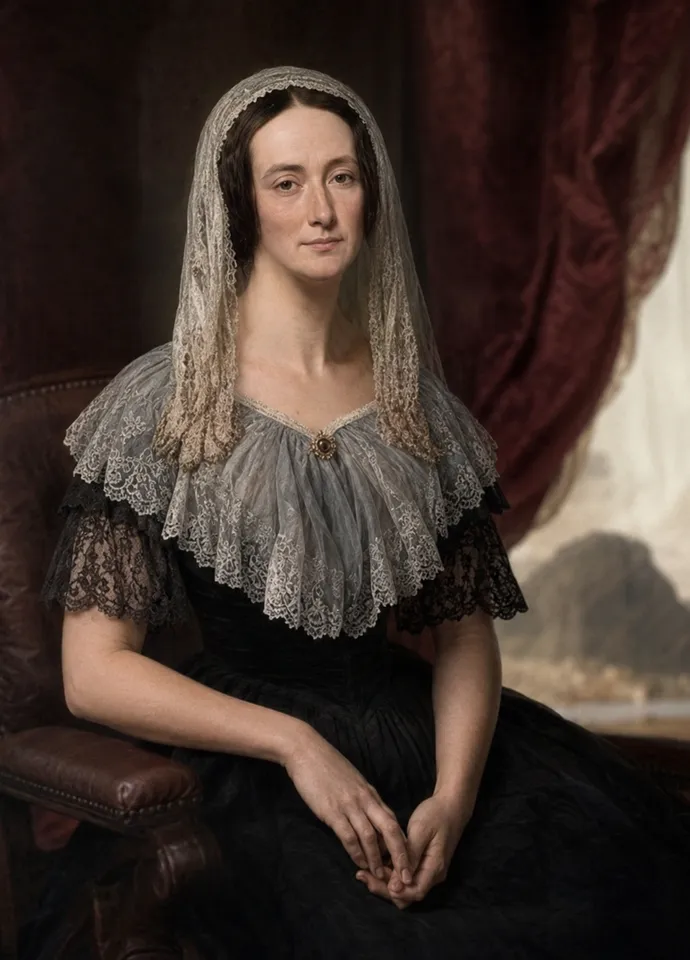
German-language editions
The diary restores the uncertain succession of days behind the familiar outline of the Kabul retreat.
The current AETERNUS editions of this author are in German. Explore the German editions →
Life and work
A life in context
Florentia Sale was born, as Florentia Wynch, at Madras in 1790 and married the army officer Robert Henry Sale in 1809. She was the wife of the later Major-General Sir Robert Sale, not a commanding officer; her authority rests on presence, close observation and the determination to keep a record.
In January 1842 she took part in the retreat from Kabul, tried to relieve the wounded and was wounded herself. Held captive from the Khurd Kabul pass, she was released in September 1842, and her journal appeared in 1843. Her husband, who had held Jellalabad, died of a wound received at Mudki in December 1845; she afterwards received a pension from the queen and died in 1853.
Honours and distinctions
- Prize · after 1845Pension of £500 a year, granted by the queen
The Dictionary of National Biography records it as recognition of her conduct and her husband's services. It names neither the monarch nor the year, and it is not an order or decoration. Her nickname, the Grenadier in Petticoats, came from her husband's fellow officers (National Army Museum); The Times called her the soldier's wife par excellence.
Explore the life and work
Origins and early years
Born at Madras, she married into the army in 1809 and followed it. The marriage brought her into the mobile households of British service in India; in Afghanistan that world of officers and families was drawn into the First Anglo-Afghan War.
From Madras to the Kabul captivity
She began her diary at Kabul in September 1841. In the retreat of January 1842 she tried to ease the suffering of women, children and the wounded; she was wounded herself and was with her dying son-in-law, Lieutenant Sturt, on 9 January. The captives were taken from Khurd Kabul on 11 January and reached Badiabad on 17 January. A British force under Sir George Pollock released her in September 1842.
Her husband, Sir Robert Sale, had defended Jellalabad. He was wounded at Mudki on 18 December 1845 and died three days later. She lived afterwards on a pension of £500 a year granted by the queen, and died in 1853, at Cape Town according to a secondary source.
The literary work
Her diary, begun at Kabul and kept through captivity, was published in 1843 and was received with critical acclaim. Its power lies in the changing horizon of knowledge: what could be seen, what was reported and what could only be feared. It should be read as testimony from a particular position within the expedition.
The legacy
Sale preserved a civilian witness to a military catastrophe. Her attention to daily necessity gives the grand narrative of imperial policy a human chronology.
A life in dates
- Born at Madras as Florentia Wynch (date and place from a secondary source)
- Marries Robert Henry Sale
- Begins her diary at Kabul
- Retreat from Kabul; wounded; Lieutenant Sturt dies on 9 January
- Captives taken from Khurd Kabul to Badiabad
- Released by Pollock's force
- Journal published by John Murray
- Sir Robert Sale dies of the wound received at Mudki
- Pension of £500 a year granted by the queen (year not stated)
- Dies (at Cape Town according to a secondary source)
Historical sources and further reading
- National Army Museum · Lady Florentia Sale, 1842 ↗
- National Army Museum · Lady Sale, 9 January 1842 ↗
- Dictionary of National Biography (1897), Sale, Sir Robert Henry (Wikisource transcription) ↗
- Dictionary of National Biography vol. 50, p. 200 (Wikisource page scan, Sale entry) ↗
- Wikipedia · Florentia Sale ↗