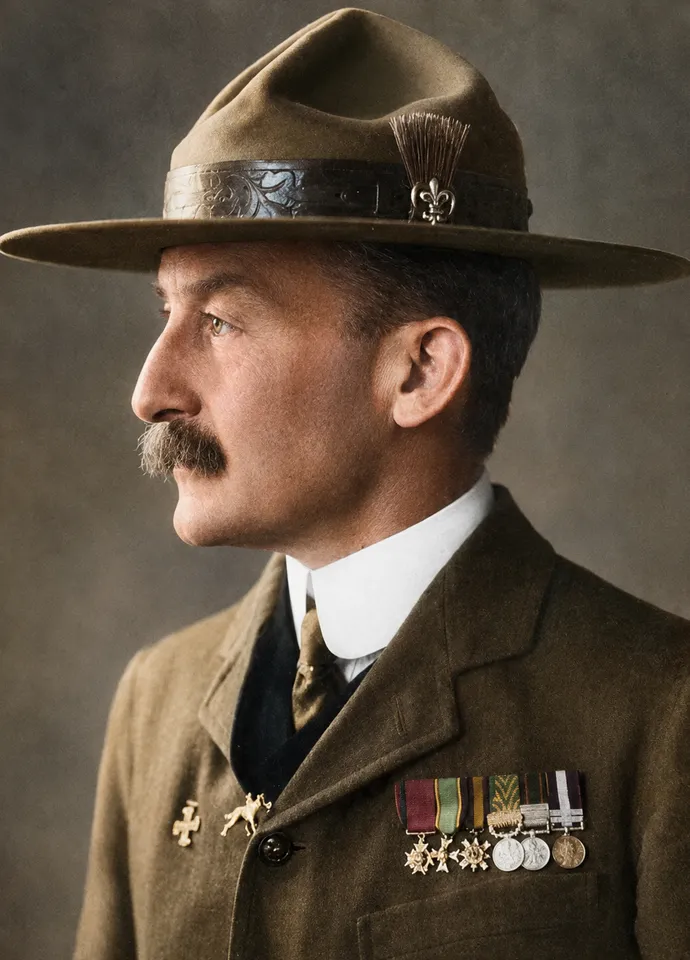
Lieutenant-General · 1st Baron Baden-Powell (1929) · OM
The cavalry officer who taught a generation to read the ground.
A handbook for soldiers found its way into the hands of schoolboys. Its author had served with the 13th Hussars in India, campaigned in Africa and won public fame defending Mafeking. On Brownsea Island, Baden-Powell set the boys exercises in observation and tracking. The camp showed how much a patrol could learn when its members had to find things out for themselves.
In The Matabele Campaign the officer records a particular war. In Aids to Scouting those habits of looking and reporting become exercises another soldier can learn.
In March 1896 the Ndebele of Matabeleland rose against the British South Africa Company. Within days the outlying settlers had been killed or driven into laagers, and Buluwayo stood besieged by its own hinterland. In June the Shona of Mashonaland followed.
First published in 1899, Aids to Scouting brought together Robert Baden-Powell’s experience of military reconnaissance in India, Afghanistan and Africa, presenting the art of observation, concealment, tracking, fieldcraft and independent action in a compact manual written expressly for the non-commissioned officers and men of the British Army.
Baden-Powell went from Charterhouse into the 13th Hussars in 1876. Service in India and campaigning in Ashanti and Matabeleland made reconnaissance a working discipline. His command at Mafeking in 1899–1900 brought him to public notice during the South African War. The South African Constabulary and the inspector-generalship of cavalry followed before he left the army as a lieutenant-general in 1910.
Aids to Scouting appeared in 1899 as a manual for the ranks. At Brownsea in 1907, boys had to make decisions for themselves in small parties. Scouting for Boys followed in 1908, putting the patrol, the camp and the exercise within reach of readers well outside the army.
Honours and distinctions
Order · 1909Order of the Bath · Knight Commander (KCB)
Promoted from Companion (CB, 1901), an appointment made after the defence of Mafeking.
Order · 1912Order of St John · Knight of Grace (KStJ)
Knight of Grace of the Order of the Hospital of St John of Jerusalem in England.
Order · 1923Royal Victorian Order · Knight Grand Cross (GCVO)
Previously Knight Commander (KCVO, 1909).
Order · 1927Order of St Michael and St George · Knight Grand Cross (GCMG)
First class of the order, announced in the King’s Birthday Honours.
Title · 1929Baron Baden-Powell, of Gilwell
Peerage. Earlier styled Baronet in the official notices.
Further distinctions
Order · 1937Order of Merit (OM)
Appointment announced on the occasion of the coronation of George VI.
Order · 1919Portuguese Order of Christ · Grand Officer
Portuguese distinction listed in the London Gazette.
Order · 1920Greek Order of the Redeemer · Grand Commander
Conferred by the King of the Hellenes and listed in the London Gazette.
Order · 1921Danish Order of the Dannebrog · Grand Cross
The date records British permission to wear the insignia.
Order · 1923Légion d’honneur · Commandeur
The date records British permission to wear the insignia.
Explore the life and work
Origins and early years
Born in London, he learned his profession in a regiment posted to India. Cavalry had to find its way over unfamiliar ground, notice what an opponent had left behind and report clearly enough for another man to act. The value he placed on small observations grew out of those demands.
The course of a life
The Ashanti expedition of 1895–96 and the Matabele campaign of 1896 advanced or secured British rule in Africa. In his account of the latter, the writer is close to the scouting, the marches and the decisions he describes. In the South African War he had charge of the besieged garrison at Mafeking until its relief in May 1900. He returned from that war with a reputation far beyond his regiment.
The literary work
Read in sequence, The Matabele Campaign, Aids to Scouting and Scouting for Boys show him writing first for the reader of a campaign, then for the soldier under instruction, and finally for boys who could practise in their own patrols. His meeting with Ernest Thompson Seton in 1906 brought him into contact with an outdoor education that already had a name and a practice of its own, Woodcraft.
Historical places
Ashanti and Matabeleland
Campaigning in 1895–96 and 1896 shaped the officer’s accounts of marching, reconnaissance and command. These were British imperial operations, fought to impose or extend British authority.
Mafeking
A besieged town in the South African War became the centre of his military reputation.
The legacy
Scouting outgrew the society in which its founder had won his first public fame. Baden-Powell was created a baron in 1929, received the Order of Merit in 1937 and died in Kenya in 1941. In the books, his public standing matters less than the practical business of finding out what happened on a patch of ground.