
GREEN
Memoirs of Lieutenant-General Scott (Annotated)
Scott recalls the War of 1812 and his formation as an American general.
Available now · Paperback, Hardcover
Explore the edition →
Life and work
1786–1866
Brevet Lieutenant General, United States Army · General-in-Chief, 1841–1861 · Gold Medals of Congress, 1814 and 1848
From the Niagara frontier to Mexico City.
Winfield Scott entered the army of a young republic and lived to advise its government at the opening of the Civil War. His memoirs trace the campaigns in which he learned to command and the decisions he later had to defend.
Return to the editions ↓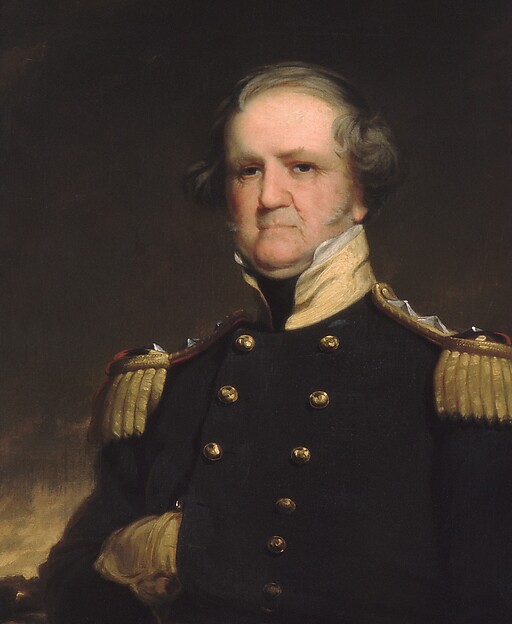
Volume I follows Scott’s formation as an officer, to 1838. Volume II turns to Mexico, the presidential campaign and the opening of the Civil War.
GREEN
Scott recalls the War of 1812 and his formation as an American general.
Available now · Paperback, Hardcover
Explore the edition →
GREEN
Scott recounts his campaign in Mexico and his later years in the United States Army.
Available now · Paperback, Hardcover
Explore the edition →Life and work
Winfield Scott was born on 13 June 1786 at Laurel Branch, his family’s farm in Dinwiddie County, Virginia. He spent a short time at the College of William and Mary and read law in Petersburg before a captain’s commission in the light artillery took him into the army in May 1808. A court-martial suspended him for a year for what he had said of his commanding general. The War of 1812 made his name: captured at Queenston, wounded at Fort George, a brigadier general in March 1814, he led the brigade that fought at Chippewa and Lundy’s Lane, came out of the war a brevet major general and received a gold medal from Congress.
For a quarter-century he shaped the peacetime army through its regulations and tactics, and the government sent him wherever it had trouble: to the Black Hawk War, to Charleston during nullification, to Florida and Alabama, to the Canadian border, and in 1838 to carry out the removal of the Cherokee Nation. In 1841 he became commanding general of the army, a post he held for twenty years. In 1847 he landed at Vera Cruz and took Mexico City, and Congress voted him a second gold medal. He lost the presidential election of 1852 as the Whig candidate. In 1855 Congress revived the grade of lieutenant general, by brevet only, and it was conferred on him with rank from 29 March 1847. In 1861 he proposed the plan of blockade and river war later called the Anaconda Plan and retired on 1 November. He wrote his memoirs in New York, published them in 1864 and died at West Point on 29 May 1866.
Resolution of 3 November 1814 for Chippewa and Niagara, with the thanks of Congress (3 Stat. 247).
Joint resolution of 9 March 1848, with the thanks of Congress, for the campaign from Vera Cruz to the capture of Mexico City (9 Stat. 333).
Honorary doctorate.
Recorded in the edition’s apparatus; the university’s own record has not been seen.
His father, a planter and Revolutionary officer, died when he was five, and his mother when he was seventeen. In 1807 he watched the treason trial of Aaron Burr at Richmond, and after the Chesapeake affair that summer he joined a volunteer troop of cavalry.
Scott’s peacetime work was administrative as much as military: boards of tactics, the General Regulations, the study of European armies. His field commands of the 1830s included the Cherokee removal of 1838, which he directed and later described in his own terms.
In Mexico he took an army from the coast to an enemy capital, for a time cut loose from its line of supply. In 1861 the Virginian stayed with the Union, held Washington and drew up the plan of blockade on which the North would fight, then gave up the command at seventy-five.
The Memoirs speak of Scott in the third person, as “the autobiographer”, and set official letters, orders and resolutions at full length beside the narrative. They are a commander’s record and a defence of his decisions, and they should be read as both.
The first edition was published by Sheldon & Company, New York, in 1864, in two volumes with a common index.
Queenston, Fort George, Chippewa and Lundy’s Lane: here Scott was captured, wounded and made a general. The brigade he drilled at Buffalo in 1814 met British regulars in the open at Chippewa.
Scott directed the removal of the Cherokee Nation from Georgia, Alabama and Tennessee between April and August 1838. The Memoirs give his side of it; the removal itself is a matter of record.
In 1847 Scott landed his army south of Vera Cruz and marched it inland by Cerro Gordo and Puebla to the valley of Mexico, for a time without a line of communication to the coast.
After his retirement Scott lived at West Point, wrote the Memoirs in New York and died at the Military Academy in 1866.
Scott gives readers a commander’s view of how the United States Army learned to campaign across a continent, and of the costs that view leaves out.